
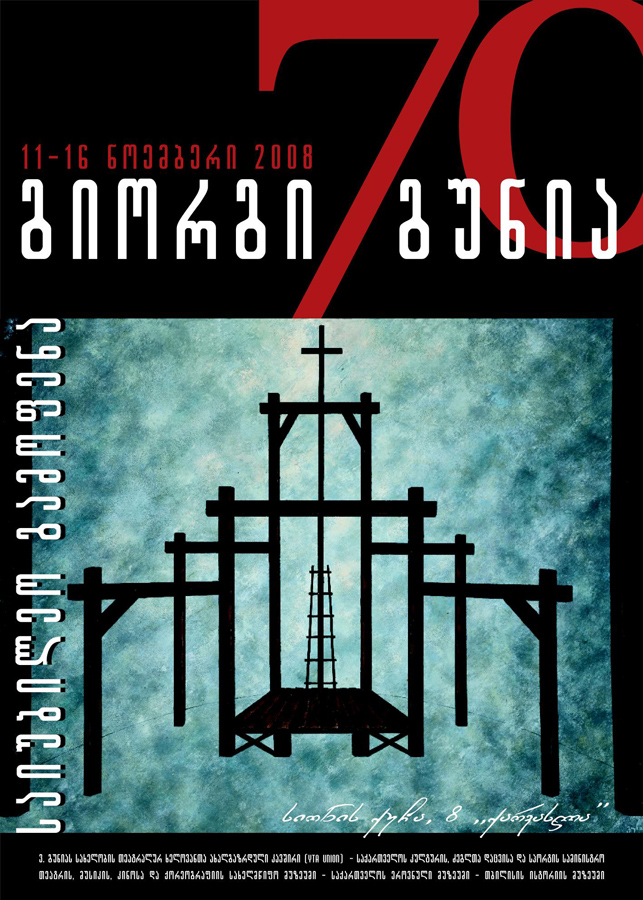
scenographer
1938 – 2001
“Every person stands alone and is unique and his purpose and mission is not to loose but to retain personal uniqueness the more so in the Art!” – that was the creative and personal credo of Giorgi Gunia who had been always set it in.
Giorgi Gunia was born in the Georgian artistic family, in Tbilisi, on October 19, 1938. He was the grandson of the prominent actor and theater director, publicist and public figure Valerian Gunia. His coming to the theater was driven by both the family traditions and the pronounced directing vision, love of theatrical world and the original and inimitable scope of artistic interpretation.
G. Gunia spent a part of his childhood and the first year of his studentship in Moscow. At first he entered the production department of VGIK (the All-Union State Institute of Cinematography.) and studied at Grigori Kosintsev’s school. The developed ability of director’s thinking and professional practice of the synthetic vision obtained there were typical for all his creative works. Then he continued his studies at the Tbilisi State Academy of Fine Arts, the theatrical-decorative art school of the Painting Department, headed by Prof. Pharnaoz Lapiashvili.
In 1966 Giorgi Gunia was graduated from the Tbilisi State Academy of Fine Arts whereupon he continued his studies at the post-graduate school. Since his studentship he had been involved in the theatrical life. In 1966 the graduate of Tbilisi State Academy of Fine Arts performed the sketches for “Hamlet” by W. Shakespeare, which became the milestone of the Georgian scenography. By that time he had already created the sublime and laconic scenery for Jean Anouilh “The Lark” (1965, director L. Mirtskhulava). The nest big victory of G. Gunia was “The Martyrdom of St. Shushanik”(1968, director S. Mrevlishvili). Those works had all qualities of a new style acting scene design.
The most remarkable works of monumental-tragic style which left a mark in the Georgian and Soviet scenography were created by G. Gunia in the 60-70-ies of the past century. The best example of this style was “King Lear” staged by director Giga Lortkipanidze at Rustavi Theater.
“The Gunia-style solution of “King Lear” scenery was put in the “gold reserves” of the scenographic Shakespeariana of Soviet and worldwide scale. It became one of the best production of the acting scenography of the 1st half of the 60-ies, a model of “the high style” characterized with the artist’s striving for solution of the global problems of human being, creation of diversified plastic images which obtained the function of a material-objective character in the performance,- wrote the art critic Viktor Berezkin in “Soviet Art” Magazine in 1984.
With his creative works Giorgi Gunia made the enormous contribution to the revival of Georgian scenography of the 60-ies. He was one of the founders of its magnificent renaissance and outlined the level and course of the Georgian scenery design. After being graduated from the Academy of Fine Arts he appeared in the center of the theater life and soon became its leader. He set scenery for more than one hundred performances. The prominent directors of various schools were pleased to work with him and very often the success of performance was highly depended on the artist. Giorgi Gunia as the scene designer was remarkable for his wide thinking, deep insight and perception of a creative work. His typical features were the monumental vision of the events of a certain production, the ability to join rationally the space, decoration and costumes designed by him.
The creative works of Giorgi Gunia are much diversified, without any genre restrictions. He could reproduce artistically both opera and theater performances.
Giorgi Gunia carried the fruitful teaching activity as well. In 1991 at Shota Rustaveli Theater Institute he established the department of fine arts which he headed. He brought up the pleiad of theater art designers.
Giorgi Gunia participated in more than 70 national and international exhibitions.
Parallel the creative and pedagogical activity the artist also worked for community. From 1981 to 1996 he had been the first secretary of the Georgian Artists Union, from 1986 – the member of the Board of the USSR Artists Union. From 1986 he had been also the member of the Presidium of the Georgian Union of Theater Workers and the member of USSR Union of Theater Workers.
In 1989 he was elected the president of the Soviet Center of International Organization of Scenographers, Theatre Architects and Technicians (OISTAT).
Since 1993 Giorgi Gunia had been the member of the National Committee of Georgia in UNESCO affairs and the president of the National Committee of AIAP, vice-president of National Committee of ICOM.
Since 1996 he had been the member of the Board for Cultural Cooperation of CIS Countries and since 1997 – the chairman of this Board. On this post he actively participated in creation and strengthening of the creative ties among CIS countries, in creation of the unified cultural space, took an active hand in implementation of various projects and endeavors,
He actively participated with the UN and UNESCO representatives in connection with the foundation of Niko Pirosmani International Artists Center in the town of Mirzaani.
Georgi Gunia was the curator, coordinator and commissar of many milestone exhibitions, the most important of which was foundation and conduct of Tbilisi Contemporary Art Biennale in 1996.
Georgi Gunia was President of the National Delphic Council Georgia, Chairperson of the Organising Committee of the I Junior Delphic Games 1997 and the II Delphic World Congress 1997. Shortly before his death Giorgi Gunia should be appointed the member of International Board of International Delphic Movement and head of South Caucasus and Middle East section.
Basic Dates
- 1938, October 19 – Born
- 1957-1958 – studied at production department of VGIK (the All-Union State Institute of Cinematography) , Grigori Kosintsev’s school
- 1960-1966 – studied at Tbilisi State Academy of Fine Arts, the theatrical-decorative art school of the Painting Department, headed by Profs. D. Tsitsishvili and Ph. Lapiashvili.
- 1967-1970 – studied at the post-graduate school of Tbilisi State Academy of Fine Arts, headed by Profs. S. Kobuladze, A. Kutateladze
- Since 1964 had carried out the active creative work at various theaters in Georgia and outside it;
- Since 1965 had participated in various national and international exhibitions;
- Since 1968 had been the member of the USSR Artists Union;
- 1970-1982 – the teacher at the painting chair of the Fine Arts Department of Tbilisi State Academy of Fine Arts;
- Since 1972 – the chairman of the Theater and Cinema Art Designers Section of the Georgian Artists Union;
- 1977 – the Lithuania Theatrical Society Award and Diploma at Vilnius Scenography Triennale;
- 1978 – awarded the title of Honorable Artist of Georgia SSR, Georgian Artists Union prize and medal for the year best work;
- 1980 – awarded the Georgian Artists Union prize and medal for the year best work;
- 1981 – secretary of the Board of Georgian Artists Union, member of presidium of Georgian Theater Workers Union;
- 1983 – member of the USSR Center of OISTAT;
- 1986 – member of the Board of USSR Theater Workers Union;
- 1987-1996 – first secretary of the Georgian Artists Union;
- Since 1986 – member of the Board of USSR Artists Union;
- Since 1986 – member of Presidium of the Georgian Theater Workers Union and member of Board of USSR Theater Workers Union;
- Since 1988 – awarded the title of People’s Artists of Georgia;
- 1989-1991 – President of the Soviet Center of International Organization of Scenographers, Theatre Architects and Technicians (OISTAT).
- Since 1990 until death – the deputy minister of culture of Georgian;
- In 1991 he founded the fine arts chair and scenography department at Shota Rustaveli State Institute for Theater and Cinema of Georgia and headed it as the chairholder and professor;
- Since 1993 – member of Georgian National Committee fro UNESCO affairs;
- Since 1994 – chairman of UNESCO fine arts section; president of the Georgian National Committee of International Association of Art at UNESCO (AIAP);
- Since 1994 – vice-president of National Committee of ICOM;
- Since 1995 he had been the member and chairman of Cultural Relationship Board of Commonwealth of Independent States (CIS) countries;
- 1995 – awarded the Theater Workers Union prize for the year best work;
- Since 1996 – had been the president of Georgian National Board of International Delphic Movement;
- Since 1997/1998 – had been elected the chairman of Cultural Relationship Board of Commonwealth of Independent States (CIS) countries and chairman of the Board of CIS Cultural Relationship Fund;
- 1996- General commissar of Tbilisi Contemporary Art Biennale
- 1997 – President of the National Delphic Council Georgia, Chairperson of the Organising Committee of the I Junior Delphic Games 1997 and the II Delphic World Congress 1997
- Since 1998 – the honorable president of Valerian Gunia Youth Union of Theater Workers;
- 2001, March 31- Death
Performances:
1. Jean Anouilh “The Lark”, 1964 -1965
K. Marjanishvili State Academic Theater, director L. Mirtskhulava
2. Giorgi Khukhashvili “The Roads”, 1966
K. Marjanishvili State Academic Theater, directors G. Lortkipanidze, I. Kakulia
3. William Shakespeare “Hamlet”, 1966 (not performed)
4. Archil Gomiashvili “In Sorrow and In Joy” (pantomime), 1967
Georgian State Philarmonic, director G. Rubin
5. William Shakespeare “Richard III”, 1967 (not performed)
K. Marjanishvili State Academic Theater, director L. Mirtskhulava
6. Eduardo De Filippo “Comedy Art”, 1967
K. Marjanishvili State Academic Theater, director M. Kuchukhidze
7. Jean Anouilh “Antigone”, 1968
Shota Rustaveli State Academic Theater, director M. Tumanishvili
8. Mikheil Mrevlishvili “Mortyrdom of St. Shushanik”, 1967-1968
K. Marjanishvili State Academic Theater, director S. Mrevlishvili
9. Eugene Schwarz “The Naked King”, 1969
School theater of Shota Rustaveli State Institute for Theater, director L. Mirtskhulava
10. Alexandre Chkhaidze “The Bridge”, 1969
Kutaisi Lado Meskhishvili State Drama Theater, director N. Gachava
11. Alexandre Chkhaidze “The Bridge”, 1969
Rustavi State Drama Theater, director N. Gachava
12. Zladislav Skovronski “Maestro”, 1969
Rustavi State Drama Theater, directors G. Lortkipanidze, A. Vasadze
13. Grigory Khugaev “My Mother-in-Law”, 1970
Vaso Abashidze State Musical Drama Theater, director Shota Meskhi
14. Alexandre Chkhaidze “The Bridge Affair”, 1970
A. Griboedov State Russian Drama Theater, director N. Gachava
15. Leonid Leonov “Invasion”, 1970
Rustavi State Drama Theater, director N. Gachava
16. Dale Wasserman, Joe Derion “Man of La Mancha”, 1970.
Rustavi State Drama Theater, directors Gia Antadze, N. Gachava (G. Lortkipanidze)
17. Giorgi Nakhutsrishvili “Ali-Baba”, 1970
K. Marjanishvili State Academic Theater, director L. Mirtskhulava
18. Vadim Korastylev “The Commendatore’s Steps”, 1971
A. Griboedov State Russian Drama Theater, director G. Lortkipanidze
19. Alexei Arbuzov “Sweet Old Home”, 1972
A. Griboedov State Russian Drama Theater, director G. Lortkipanidze
20. Amiran Abshilava “The Caucasian Mountains”, 1972
A. Griboedov State Russian Drama Theater, director L. Paksashvili
21. Konstantine Lortkipanidze “Kolkhida Dawn”, 1972
Shota Rustaveli State Academic Theater, director L. Mirtskhulava
22. Niko Lortkipanidze “The Evil of Times”, 1973
K. Marjanishvili State Academic Theater, director M. Kuchukhidze
23. Alexei Vampilov “Last Summer”, 1973
A. Griboedov State Russian Drama Theater, director J. Alexishvili
24. Jules Romains “Knock ou le Triomphe de la médecine”, 1973
Student theater of I.Chavchavadze State Teacher’s Institute of Foreign Languages, director L. Mirtskhulava
25. Robert Thomas “8 Femmes”, 1973
A. Griboedov State Russian Drama Theater, director L. Paxashvili
26. Konstantin Simonov “So Be It”, 1973
A. Griboedov State Russian Drama Theater, director K. Surmava
27. William Shakespeare”King Lear”, 1972-1973
Rustavi State Drama Theater, directors G. Lortkipanidze, A. Vasadze
28. Joseph Bukovchan “ Before the Cock Crows”, 1974
A. Griboedov State Russian Drama Theater, director Leila Jashi
29. William Shakespeare “Othello”, 1974 (not performed)
30. William Shakespeare “Hamlet”, 1974
Northern Ossetia State Drama Theater, director G. Khugaev
31. Revaz Lagidze “Lela”, 1974-1975
Tbilisi Zakharia Paliashvili State Academic Theater of Opera and Ballet, director G. Zhordania, conductor G. Azmaiparashvili
32. Alexandre Chkhaidze “While the City Sleeps”, 1975
K. Marjanishvili State Academic Theater, director N. Gachava
33. Valerian Kandelaki “Socrates”, 1976
K. Marjanishvili State Academic Theater, director M. Kuchukhidze
34. Peter Tchaikovsky “The Queen of Spades” , 1975-1977
Tbilisi Zakharia Paliashvili State Academic Theater of Opera and Ballet, directors G. Zhordania, T. Abashidze, conductor G. Azmaiparashvili
35. Vladimir Vaneev “Khilak Fortress”, 1978
K. Khetagurov Southern Ossetia State Drama Theater, director G. Khugaev
36. Levan Sanikidze “The Gypjaks”, 1978
Rustavi State Drama Theater, director T. Meskhi
37. Valerian Agarnovsky “Stop Malakhov, 1979
State Russian Youth Theater, director E. Basilashvili
38. Revaz Lagidze “Lela”, 1979 (new production)
Tbilisi Zakharia Paliashvili State Academic Theater of Opera and Ballet, director G. Zhordania, conductor G. Azmaiparashvili
39. Friedriech Dürrenmatt “Romulus the Great”, 1979-1980
K. Marjanishvili State Academic Theater, director N. Gachava
40. Prosper Mérimée “Le Théâtre de Clara Gazul” , 1980 (“Une femme est un diable”, “Le Carrosse du Saint-Sacrement”)
Metekhi State Youth Theater-Studio, director M. Areshidze
41. Alexander Kazantsev “Old House”, 1980
A. Griboedov State Russian Drama Theater, director G. Zhordania
42. Sandro Mrevlishvili “Martyrdom of Kola Children”, 1981
Metekhi State Youth Theater-Studio, director Sandro Mrevlishvili
43. Léo Delibes “Sylvia”, 1982
Perm P. Tchaikovsky State Academic Theater of Opera and Ballet, ballet-master G. Alexidze
44. Nina Pavlova “The House-trailer”, 1982
A. Griboedov State Russian Drama Theater, director G. Zhordania
45. Valentin Rasputin “To Live and Remember”, 1982
K. Marjanishvili State Academic Theater, director N. Gachava
46. Alexander Sumbatov-Yuzhin “Unfaithfulness”, 1983
A. Griboedov State Russian Drama Theater, director G. Zhordania
47. Alexander Skryabin “Prometheus” (film-ballet), 1983-1984
Georgian TV Film Studio, Georgian SSR Public Broadcasting Committee, director Z. Kakabadze, ballet-master M. Lavrovski
48. Alexei Dudarev “Rank and File”, 1984-1985
A. Griboedov State Russian Drama Theater, director G. Zhordania
49. Euripides “Medea”, 1984-1985
Poti V. Gunia State Academic Theater, director L. Mirtskhulava
50. Alexander Sukhovo-Kobylin “Death of Tarelkin”, 1985
A. Griboedov State Russian Drama Theater, director D. Tsiskarishvili
51. Jaba Ioseliani “Mary the Queen”, 1990
K. Marjanishvili State Academic Theater, director M. Kuchukhidze
52. Kote Makharadze, levan Sanikidze “The Bagrationis”, 1992
“Veriko” – one-actor theater, director K. Makharadze
53. Akaki Baqradze, Kote Makharadze “Ilya Chavchavadze”, 1987
“Veriko” – one-actor theater, director K. Makharadze
54. Kote Makharadze “Stalin”, 1998
“Veriko” – one-actor theater, director K. Makharadze
55. Jean-Paul Sartre “The Devil and the Good Lord”, 1994 (not-performed)
Shota Rustaveli State Academic Theater, director L. Mirtskhulava
56. Grigol Robakidze “Lamara”, 1995
Batumi State Drama Theater, director L. Mirtskhulava
57. Jean Anouilh “The Lark”, 1995 (the 1964 -1965 production)
Batumi State Drama Theater, director L. Mirtskhulava